Outcome: I helped turn an underdeveloped aimswebPlus lead pipeline into a coordinated education-assessment demand-generation program. The campaigns generated thousands of leads per month and, with Sales collaboration and lead scoring, hundreds of marketing-qualified leads monthly.
The challenge. aimswebPlus needed a sustainable way to reach educators and district decision-makers, explain the value of benchmark assessments, and generate qualified interest. A generic product message could not address the very different priorities of teachers, school administrators, and district leaders.
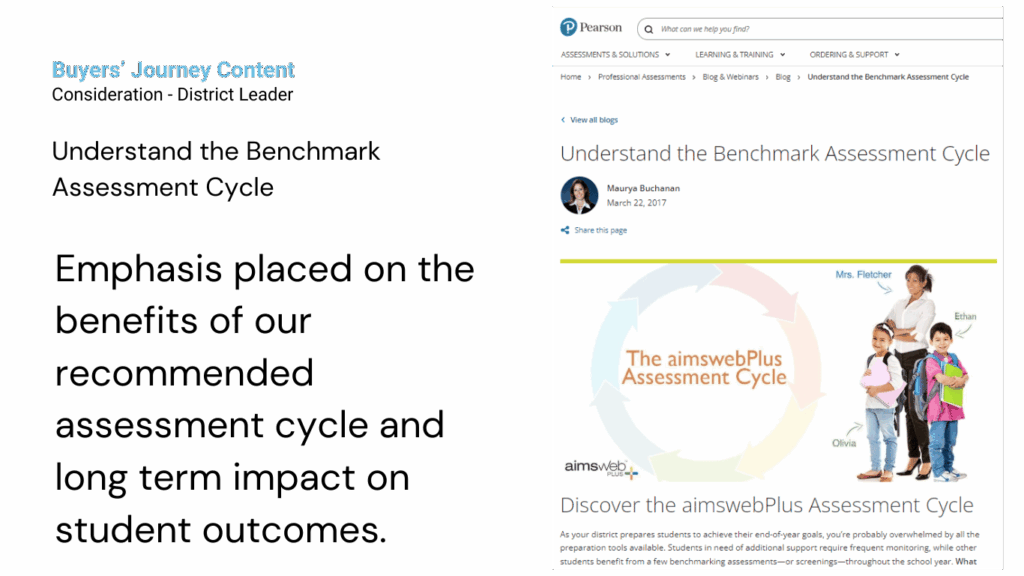
Meet Olivia, Ethan, and their Teacher Mrs. Fletcher
My role. I developed audience personas and buyer journeys, mapped existing content, identified gaps, and helped shape the campaign strategy and content. I collaborated with Sales and Product Management on audience insights and lead qualification.
The creative approach. Our team built a year-long narrative around Mrs. Fletcher and her student Olivia, showing how assessments could support baseline understanding, parent-teacher conversations, and instructional adjustments during the year. We supplemented this story with role-specific content for different buying stages.
Execution and iteration. We used blogs, social media, paid advertising, retargeting, email, and SEO to reach buyers across awareness, consideration, and decision. I used search behavior, campaign analytics, and A/B testing to adjust message and channel choices as the program developed.
What mattered. This was not simply about producing more content. We made assessment messaging relevant to specific decision-makers, connected content to their questions at each buying stage, and aligned marketing activity with sales qualification.
Research and Audience Insights
Keyword research: Making sure we are using the same terminology that our users use to find content
Web behavior data: Search reports gave us ideas for content marketing
Sales and Product Management insights: Provided better understanding of the key content that was working in past engagements with the customer
Market Research: EdWeek, EdSurge, ASCD/ISTE, Learning Policy Institute, eSchool News
Persona Needs and Message Strategy
Teachers:
Time-Consuming
Lack of Real-Time Insights
Differentiation Challenges
School administrators:
Data Overload
Ease of Use for teachers (require less professional development)
Compliance and Accountability
District Leaders:
Equity and Access
Optimizing Instructional Alignment with Assessment
Stakeholder Communication / Reporting
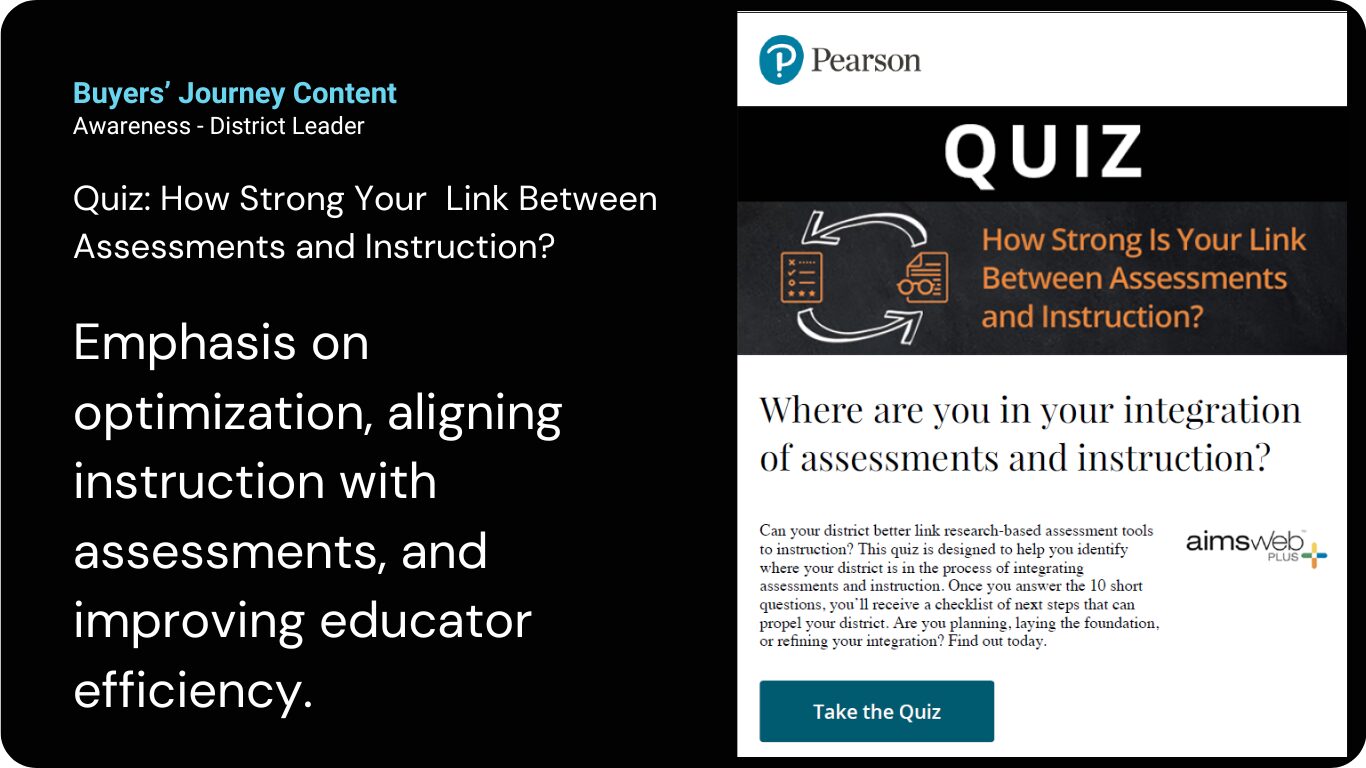
Buyers’ Journey Phase - Awareness
Teachers: Struggling with grading efficiency, differentiated instruction, or aligning assessments with curriculum
School Administrators: Looking for ways to better track student progress, improve teacher efficiency, and meet state requirements
District Leaders: Concerned with district-wide consistency, equitable assessment, and ensuring compliance with accountability standards
Buyers’ Journey Phase - Consideration
Teachers: Looking for ease of use and adaptability to student needs.
School Administrators: Investigating features like data integration, reports, ease of use / professional development offerings, and compliance with state testing
District Leaders: Evaluating the scalability of solutions, cost-effectiveness, and long-term impact on student outcomes
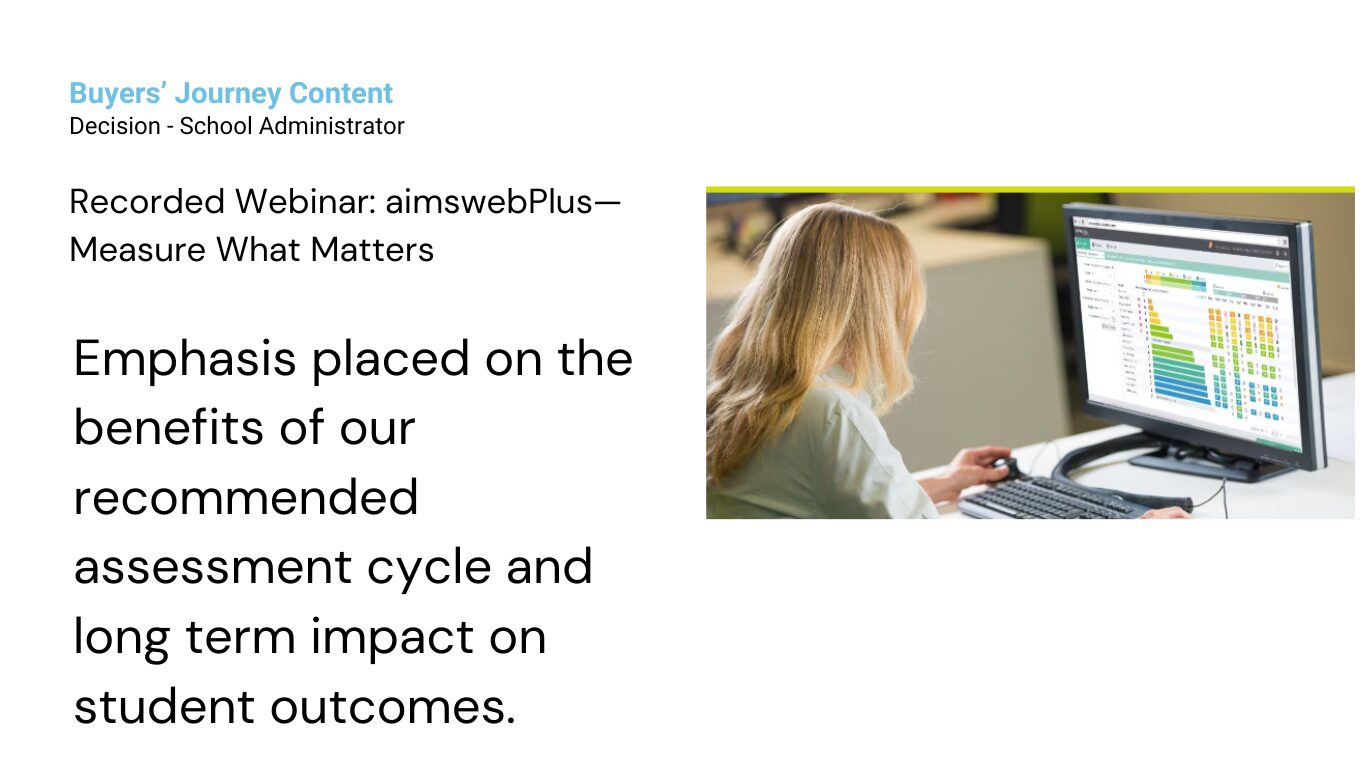
Buyers’ Journey Phase - Decision
Teachers: Likely influencing or supporting the decision with direct input based on ease of use in the classroom
School Administrators: Making the purchasing decision based on budget, efficacy, compatibility, and ease of use / professional development support.
District Leaders: Finalizing deals based on district-wide needs, long-term support, implementation plans, and ensuring alignment with strategic goals
Campaign Content by Buyer Journey
Examples of the content we developed for different audiences and buying stages. These illustrate how the campaign moved from broad education needs to more specific evaluation and decision support.